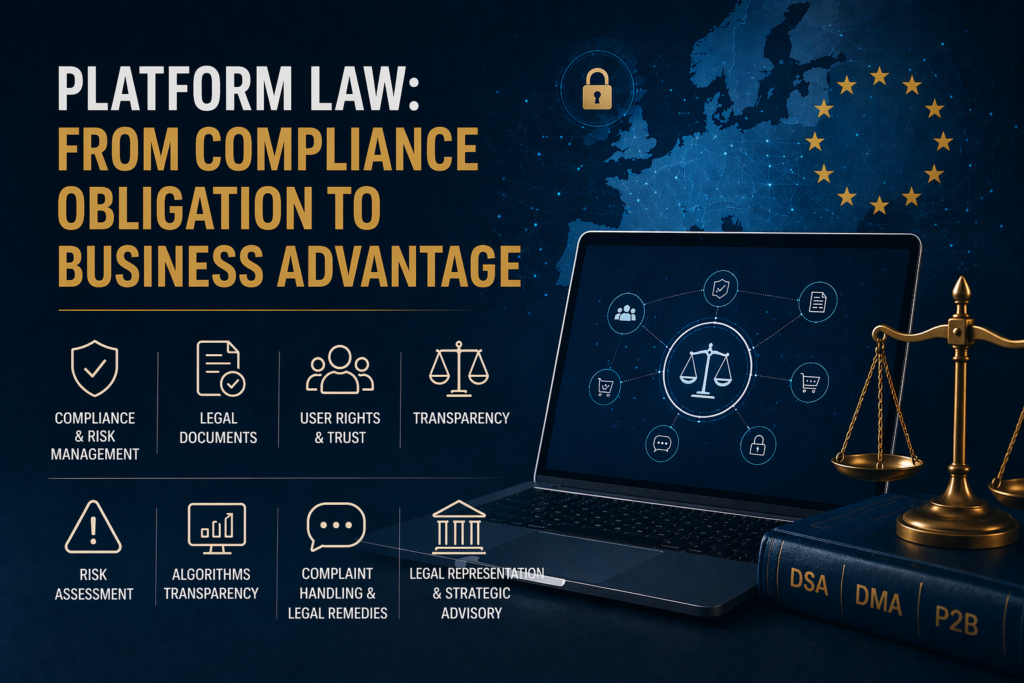
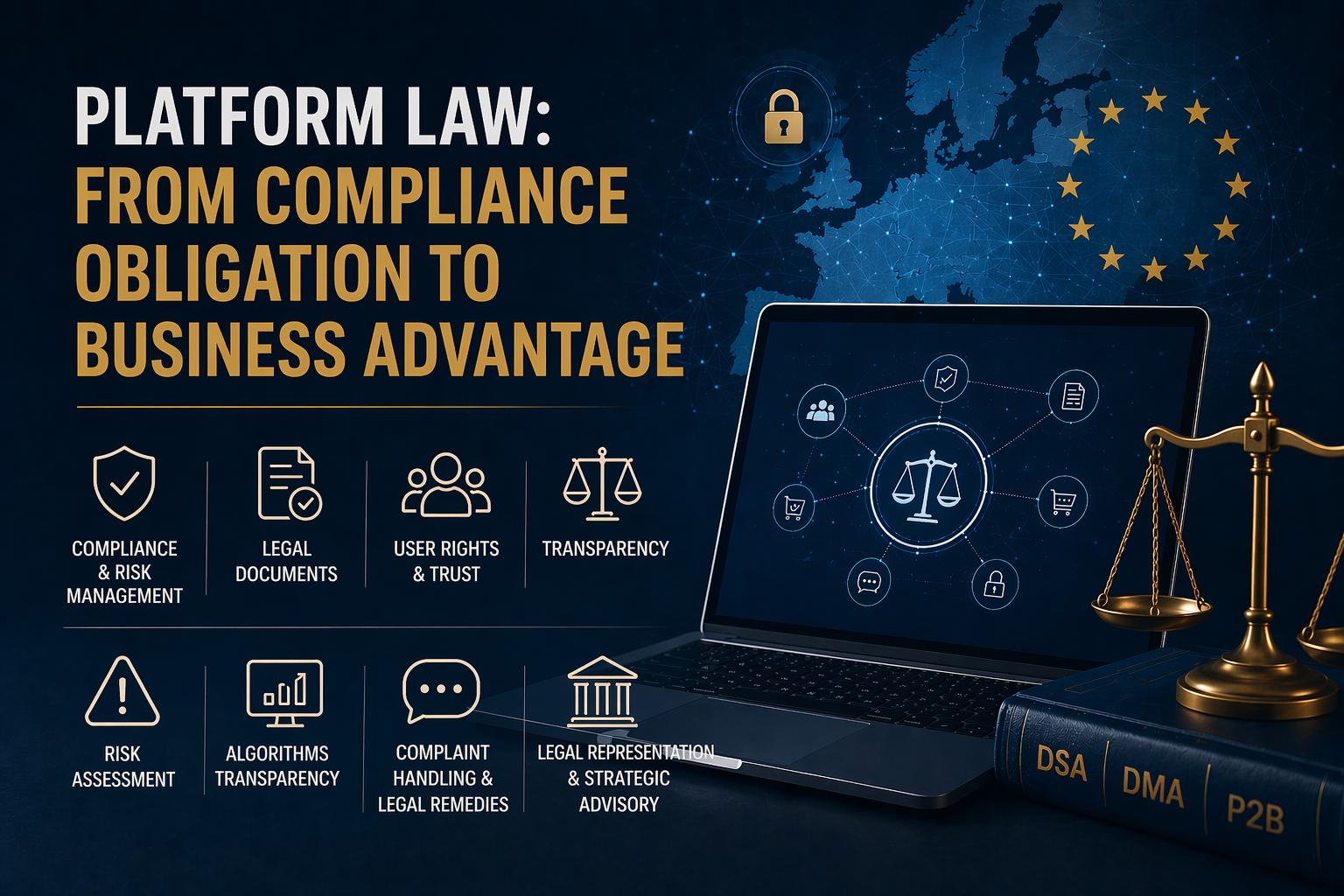
Operating online platforms in the EU today
The world of online platforms is no longer just a technological but a significant legal one. The European Union’s regulatory framework fundamentally defines how platforms must operate and what users are entitled to expect. In this environment, the question is not whether compliance is necessary, but how it can be achieved efficiently and in a way that also creates business value.
We help you do exactly that—not only through legal interpretation, but with practical, implementable solutions.
What we provide
We offer comprehensive, practice-oriented platform law support that goes beyond theory:
- Rapid legal assessment
We determine which EU rules apply to your service and what obligations you must comply with. - Full compliance system design
We help you build or restructure internal processes—from content moderation to algorithmic transparency. - Review and redesign of Terms & Conditions, privacy notices, and other legal documents
We draft documents that are not only legally compliant, but also operationally effective. - Content and complaint handling systems
From “notice and action” mechanisms to full legal remedy processes. - Legal audit of algorithms and recommender systems
We help make system operations transparent and legally compliant. - Risk assessment and regulatory readiness
We prepare your platform for inspections, investigations, and potential sanctions. - Legal representation and strategic advisory
Whether you are a platform operator or a user involved in a dispute.
What is a platform — and why is it legally unique?
A platform is an online infrastructure that connects different groups of users and facilitates interaction between them. It does not create the content or services itself— it operates as an intermediary.
Examples include: app stores, social and professional networks, online marketplaces, service-intermediating platforms.
Platforms often act as “gatekeepers,” significantly influencing who can access markets or information and under what conditions. Their operations are heavily data-driven, which raises important data protection and consumer protection issues.
For this reason, they are subject to specific regulatory frameworks.
The three key EU regulations
Digital Services Act (DSA)
The core framework for digital services, which: defines platform liability, requires handling of illegal content, imposes transparency obligations and user rights protections.
Digital Markets Act (DMA)
Applies only to the largest platforms and: restricts anti-competitive practices, ensures fair market conditions.
Platform-to-Business (P2B) Regulation
Regulates the relationship between platforms and business users: requires transparent contractual terms, protects smaller business actors.
What this means for platform operators
Platform operation is now not only a technical and business matter, but a complex legal compliance task. This includes, among others: operating systems for handling illegal content, transparent content moderation mechanisms, effective complaint and appeal systems, clear and understandable terms of service, explanations of recommendation algorithms, internal compliance structures.
For larger platforms systemic risks must also be managed (e.g. disinformation, fundamental rights impacts).
What this means for users
The regulatory framework strengthens user rights: content cannot be removed and accounts cannot be suspended without justification, complaint handling and legal remedies must be provided, algorithmic processes become more transparent, users gain greater control over their personal data.
This also means that platform decisions can increasingly be challenged legally.
When to contact us
As a platform operator
- if it is unclear which rules apply to your website/platform,
- if you need to build or revise moderation, reporting, or complaint systems,
- if the compliance or transparency of your algorithms is in question,
- if a regulatory investigation is expected or ongoing,
- if your legal documents (T&C, privacy policy, cookie-policy, etc.) need updating.
As a user
- if your content has been removed without justification,
- if your account has been suspended or visibility negatively affected by algorithms,
- if you have not received proper explanation or legal remedy,
- if you experience data protection or algorithmic transparency issues.
The key takeaway
Platform law is not just a new legal field—it is both a business risk and an opportunity. Those who manage it well gain a competitive advantage. Those who do not, expose themselves to significant legal and reputational risks.
We help ensure you are in the first group.
If you operate a platform—or are affected as a user—it is worth taking action early.
Today, the operation of online platforms is governed by strict EU rules. The question is not whether platform law affects you—but how you can turn it into an advantage.
We provide tangible, practical support: not merely interpreting the law, but building working systems, processes, and solutions tailored to your business.